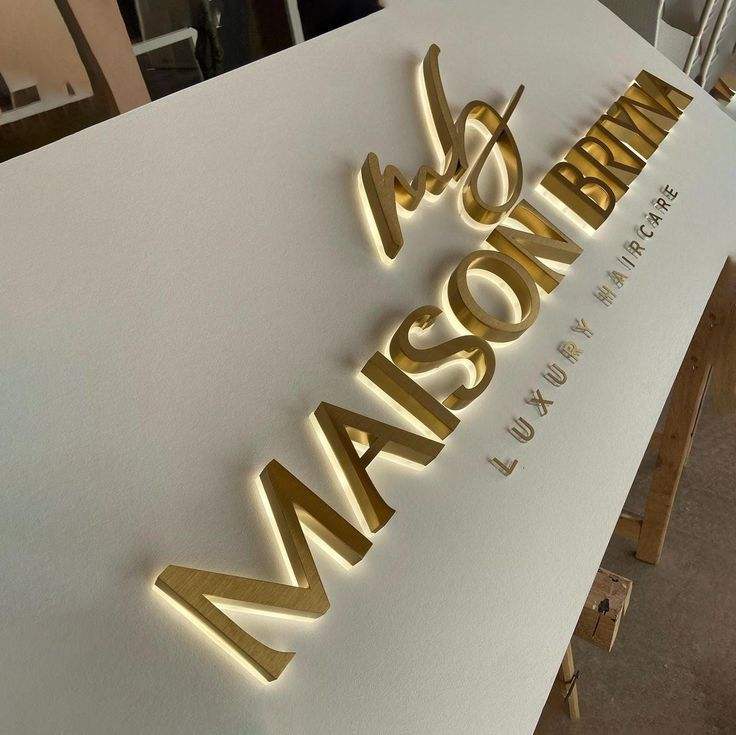
Stainless steel letters can refer to more than one type of construction. A flat-cut letter is described around its cut profile and material thickness. A built-up or fabricated letter has an assembled body with a face and side returns. Do not use the apparent depth in a photograph as a substitute for a construction description.
Separate the dimensions you need
Show the overall layout width, letter heights and unit of measurement. Identify whether a depth measurement describes a solid material thickness, an assembled letter body or the distance from the wall to the front face. A drawing with a labelled side view can resolve an ambiguity that several perspective photographs leave open.
Review the small details of the artwork
Identify narrow strokes, small enclosed spaces, fine serifs and closely spaced characters for manufacturing review. Avoid assuming that every outline scales to every size or construction. Ask the supplier to identify proposed artwork adjustments and get the revised visible design approved before it is treated as the production version.
Specify appearance independently
Record the required base material and grade if the project has a defined specification, then describe the finish. A gold appearance alone does not identify the metal or surface process. Where several letters must look consistent, include the face, returns and visible edges in the sample review rather than approving only the front surface.
Decide whether illumination is part of the scope
A metal letter body does not by itself mean the design is illuminated. State whether the letters are non-illuminated, halo-lit or use another agreed light effect. Include site and access information when discussing mounting, cable routes and supporting components. Confirm which party will resolve the local installation details.
Keep construction choices visible in the quote
Ask the quotation and approved drawing to use the same construction description. If a supplier proposes an alternative, review the visible result, interfaces and included work as a separate option. Similar-looking lettering can still require a different order brief, so compare the written scope as well as the reference image.
Construction comparison
These are brief-writing distinctions, not universal size or thickness limits. Review the actual design with the manufacturer before selecting a construction.
| Brief item | Flat-cut lettering | Built-up lettering |
|---|---|---|
| Body description | Cut profile and material thickness | Assembled face, returns and body depth |
| Side-view question | Edge appearance and wall projection | Face/return relationship and overall projection |
| Finish review | Visible face and cut edges | Face, returns, joins and other visible surfaces |
| Fixing discussion | Actual profile, surface and proposed attachment | Body, access, supporting arrangement and wall interface |
| Illumination | Specify separately if required | Specify separately; an assembled body does not imply lighting |
The stainless steel letter page is the product starting point. The broader metal lettering range is relevant when the required material has not yet been selected.
An example of a depth ambiguity
Suppose a drawing says 40 mm deep without a side view. That could be intended as letter-body depth or as the total distance from wall to face. This illustrative ambiguity should be resolved on a drawing: show body depth, any projection behind the body and the final wall-to-face relationship. The number is an example, not a recommended construction or a manufacturing limit.
Approval questions before the order is released
- Is the approved visible outline the version being priced? - Is depth defined in the same way in the drawing and quotation? - Are the face, edge and side-return appearances recorded? - Is illumination explicitly included or excluded? - Has the installation interface been reviewed by the responsible party?
Use the finish approval notes to document appearance. If a physical reference is being used, keep the sample review record with the same revision. These documents answer different questions and should remain connected.
References & further reading
External manufacturer or carrier guidance supports the terminology and general considerations discussed here. Their product specifications and policies are specific to their own services.
Prepared as a purchasing discussion aid. Confirm the specification, installation responsibilities and applicable requirements for your project.